.png)
1、Tank Top Section
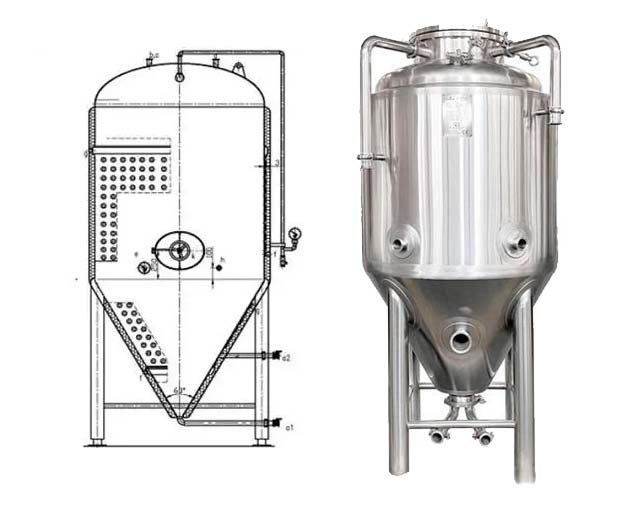
The tank top features a dome-shaped structure with a central opening for installing a removable large-diameter flange to accommodate CO₂ and CIP piping and their connections. The tank top is also equipped with vacuum breakers, overpressure valves, pressure sensors, etc. A washing device is installed on the inner side of the tank, along with platforms and access ways for top operation.
2、Tank Body Section
The tank body is cylindrical and constitutes the main part of the fermenter. The height of the fermenter depends on the diameter and height of the cylinder. Due to the large diameter and low pressure resistance, the diameter of a typical conical tank generally does not exceed 6 meters. Fabrication of the tank body is easier than that of the top. The exterior of the tank body is used for installing cooling devices and insulation, with space reserved for installing temperature and pressure measurement elements. The cooling layers on the tank body come in various forms, such as coils, dimpled plates, or jackets, and are divided into 2-3 sections. Pipes lead from these sections to connect with the cooling medium inlet pipes. The cooling layer is covered with insulation materials like polyurethane foam, which is then encased in an aluminum alloy or stainless steel sheet. Colored steel plates are also sometimes used as a protective layer.
3、Conical Bottom Section
The included angle of the conical bottom is generally 60º to 80º, though some are 90º to 110º, the latter typically used for larger capacity fermenters. The height of the conical bottom is related to its angle; the smaller the angle, the higher the cone bottom. Generally, the height of the cone bottom accounts for about 1/4 of the total tank height, and should not exceed 1/3. The outer wall of the conical bottom should be equipped with a cooling layer to cool the yeast sedimented at the bottom. The cone bottom should also be fitted with inlet/outlet pipes, valves, sight glasses, and temperature and pressure sensing elements.
Additionally, the ratio of tank diameter to height is typically between 1:2 and 1:4. The total height should preferably not exceed 16 meters to avoid strong convection currents that could affect the sedimentation of yeast and trub. The tank can be constructed from stainless steel or carbon steel. If carbon steel is used, the inner wall must be coated with a non-toxic coating that does not affect the beer’s flavor. The working pressure of the fermenter is determined by its operational requirements, typically controlled between 0.2 and 0.3 MPa. The inner wall of the tank must be smooth and even. The interior of stainless steel tanks should be polished, while the coating on carbon steel tank interiors must be uniform, free from unevenness, and without granular protrusions.
-300x83.png)