.png)
The beer mashing system primarily consists of a cereal cooker, mash tun, lauter tun, brew kettle, and whirlpool tank. These components form the mashing system of a large-scale brewery. The main body of each functional vessel within the mashing system is constructed using high-quality international standard 304 stainless steel. Utilizing modern manufacturing technologies such as automatic plasma cutting, laser cutting, and pure argon shielded welding, all internal surfaces that come into contact with the mash are mirror-polished, while the exteriors receive a satin (brushed) polish finish. This ensures customers receive a mashing system that is technologically advanced, offers excellent value for money, and is luxurious in appearance.
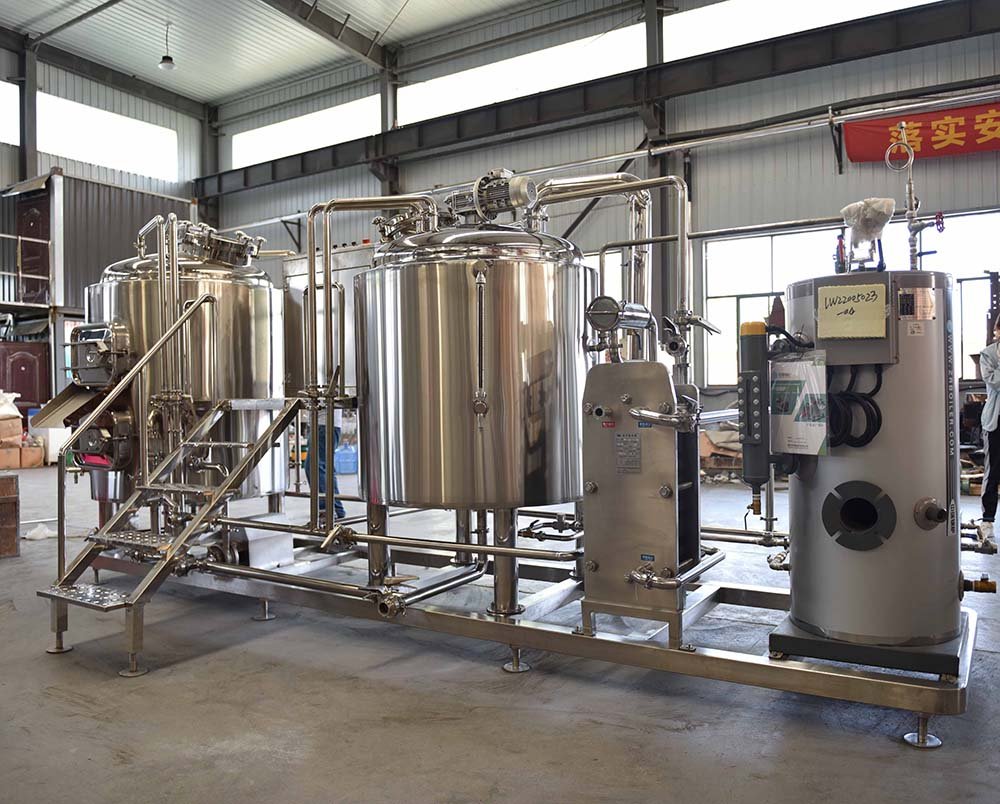
- Cereal Cooker
The function of the cereal cooker is to mix rice flour and a small portion of malt flour with water, bring the mixture to a boil, and use it to heat the mash, facilitating the liquefaction and gelatinization of starches.
(1) Structure of the Cereal Cooker
The body is cylindrical, with a dished or ellipsoidal jacketed bottom and a domed top cover. Internally, it is equipped with an agitator. The bottom has a heating device, and the exterior is insulated. The milled rice flour, malt flour, and hot water are mixed and fed in via a flour feeding tube and water inlet pipe. With the help of a propeller-type agitator, the consistency and temperature of the viscous mash are kept uniform, keeping heavier particles suspended and preventing them from settling on the bottom to form “crust” or scorching, thus avoiding localized overheating of the mash near the heat transfer surface.
Why are adjuncts added? Many believe that using low-cost, starch-rich cereals as adjuncts can increase wort yield and produce cheaper wort, aiming to reduce costs. However, this is only one reason. Another is that adjuncts contain significantly lower levels of protein and oxidizable polyphenols compared to malt, which helps reduce beer color, improve flavor, and enhance the non-biological stability of the beer. Cereal cookers are primarily seen in breweries and educational institutions; the craft beer industry typically uses pure malt, so cereal cookers are not used. - Mash Tun
- Utilizes high-efficiency Müller plate jacket heat exchange technology, applying scientific principles of steam turbulence to maximize heat transfer and energy savings. Combined with fully automated temperature control, it ensures precise temperature increase rates and hold times for all mashing and gelatinization stages.
- Employs an internationally advanced suspended speed control system with frequency conversion and automatic stirring control. This ensures uniform mixing of the mash during gelatinization and saccharification, maximizing the biological activity, conversion, and catalytic effects of various enzymes. This fundamentally guarantees optimal beer quality and the highest possible yield.
- Lauter Tun
- Features an advanced, scientifically designed profiled plow blade system and hydraulic automatic lifting technology. This ensures uniform turning of the spent grain bed and smooth discharge, increasing filtration speed and production efficiency while maintaining excellent wort clarity and extract yield.
- Equipped with an internationally advanced suspended stirring device, incorporating frequency conversion, speed regulation, and automatic control technology. This makes operation more convenient and flexible, simplifies maintenance, and reduces costs.
- Brew Kettle
- Applies advanced internal boiling and pressurization technology to increase boiling intensity. This significantly enhances the evaporation of Dimethyl Sulfide (DMS) precursors, promotes the coagulation of proteins and other coagulable substances, and enables rapid separation of the boiled wort from the coagulum (trub).
- Employs external recirculation mixing technology to accelerate the temperature increase rate during the initial boiling phase. This maintains a consistent, uniform temperature throughout the wort during heating, preventing localized overheating that could cause denaturation of soluble components, thereby ensuring high boiling quality.
- Whirlpool Tank
- Designed based on optimal spent grain accumulation per unit filtration area. The tank’s diameter-to-height ratio is increased to reduce whirlpool velocity, promoting the settling and coagulation of trub for optimal separation.
- When equipped with a hot trub tank, it can increase wort yield and also reduce environmental pollution.
The complete beer mashing system is composed of these five functionally distinct vessels. The above information is provided to help everyone understand the functions within a mashing system. Next, Lao Qian will guide you through understanding the types of mashing systems used in brewery equipment.
- Two-Vessel Mashing System
This type of equipment is currently quite common in the industry. It mainly consists of a combination mash/lauter tun and a combination brew/whirlpool tun. The function of the mash/lauter tun is mashing and lautering. The function of the brew/whirlpool tun is boiling and whirlpooling. If a hot water tank is added, production efficiency can increase by 50%.
Advantages of the Two-Vessel System:
① Simple equipment, lower initial investment.
② Simple piping, easy to operate.
③ Low equipment height, not demanding on ceiling height.
Main Disadvantages:
① Wort filtration can only be done by underletting/siphoning (i.e., the mash is in the lauter tun, and wort is extracted using a wort pump to transfer it to the brew/whirlpool tun). Filtration speed is relatively slow, requiring high brewer skill. Operational errors can lead to a compacted grain bed making lautering difficult, or worse, deformation of the false bottom, affecting future use.
② In the brewing equipment manufacturing industry, a stirrer is often installed in the brew kettle. Because the kettle also functions as the whirlpool, the stirrer can negatively impact whirlpool sedimentation.
③ Sparge water must be prepared in advance and stored in a separate container or a fermentation tank (generally not recommended to store in fermenters, as improper operation can create a vacuum in the tank or affect the glycol system). This is cumbersome and leads to higher heat loss.
④ To minimize the impact on whirlpool sedimentation, this type of equipment generally does not have an anti-vortex cross installed inside the combination brew/whirlpool tun. The anti-vortex cross is typically installed inside the mash/lauter tun to prevent vortex formation during transfer. Obviously, without an anti-vortex device, transferring from the brew/whirlpool tun can easily create a vortex, drawing air into the wort pump. This can cause “air binding” in the pump, or in severe cases, “cavitation” due to large amounts of gas entering, affecting the pump’s lifespan.
⑤ Mashing is limited to the infusion method, with fewer temperature steps, placing higher demands on malt quality.
⑥ Typically, a maximum of two brews per day is possible, often requiring the brewer to work overtime.
Note: Air binding occurs when air mixes with the liquid inside the pump head of a centrifugal pump, preventing the low-pressure zone at the impeller center from drawing in liquid, thus stopping fluid transfer. Cavitation is the phenomenon where vapor bubbles form due to localized pressure drops in the flowing fluid. Pump cavitation leads to erosion of components, reduced head, vibration, and noise. Prolonged exposure can cause pitting, cracks, or even sponge-like damage on the impeller surface due to repeated impact forces and chemical corrosion from dissolved oxygen. - Combined Three-Vessel Mashing System (Two-Body, Three-Vessel)
This type of equipment typically consists of a brew kettle + a combined lauter/whirlpool vessel. The combined lauter/whirlpool vessel actually has a two-layer structure: the upper part is the lauter tun, and the lower part is the whirlpool tank. It is commonly found in brewpubs and brestaurants.
Advantages of the Combined Three-Vessel System:
① More compact and saves floor space compared to a standard three-vessel system.
② The brew kettle’s steam jacket often has a large heating surface area, resulting in fast升温 rates.
③ The lauter tun sits above the whirlpool, allowing for natural filtration (wort flows by gravity). Filtration is fast, and wort clarity is high. Even with operational errors, problems like false bottom deformation from a compacted grain bed are less likely.
④ The whirlpool tank is a dedicated vertical cylindrical tank with a tangential inlet, resulting in better separation of hop trub and hot break.
⑤ While the wort is lautering, the brew kettle can be used to heat sparge water. Simultaneous sparging during lautering is possible, shortening the total mashing time by 30-50 minutes. This system has higher utilization than the two-vessel system.
⑥ Typically, two batches can be brewed during a daytime shift. With overtime, 3-4 batches per day are possible, allowing for maximum beer production in the shortest time during peak sales periods.
Main Disadvantages:
① The equipment is generally taller than traditional two-vessel systems, requiring sufficient ceiling height.
② The initial investment is higher than the traditional two-vessel system. The maximum volume for combined three-vessel systems is typically around 1000L, with limitations on capacity. - Three-Vessel Mashing System (Three-Body, Three-Vessel)
This type of equipment is common in small to medium-sized breweries. There are several configuration options, with common combinations being:
① Mash Tun + Lauter Tun + Brew/Whirlpool Kettle
② Mash/Lauter Tun + Brew Kettle + Whirlpool Tank
③ Mash/Brew Kettle + Lauter Tun + Whirlpool Tank
Generally speaking, although configurations vary, the core principles remain the same.
Main Advantages:
① Daily brewing capacity is similar to the combined three-vessel system.
② Equipment height is relatively lower.
③ Multiple configuration options available, and can potentially be upgraded to a four-vessel system later.
Main Disadvantages:
① Filtration is typically limited to underletting/siphoning.
② Larger equipment footprint and higher investment cost. - Four-Vessel Mashing System
This type of system is common in small or medium-sized breweries. It typically includes a hot water tank in addition to the main mashing vessels, significantly improving production efficiency.
Main Advantages:
Clear division of labor among separate vessels reduces turnaround time and increases production efficiency, achieving a maximum of 5 brews per day.
Main Disadvantages:
① Larger equipment volume and footprint. Under current transportation conditions, the maximum size for this type of prefabricated system is around 3000L. Larger capacities would require on-site fabrication/installation.
② Higher investment cost.
-300x83.png)